Dumbbell Squats for Health

Sophie
| 23-09-2026
 · News team
Dumbbell squats are a practical resistance exercise that targets the lower body while requiring coordination and postural control.
Adding a manageable weight increases the physical demand of the movement, making dumbbell squats a useful option for people incorporating strength exercises into a regular fitness routine.
How Dumbbell Squats Work
Dumbbell squats primarily involve the quadriceps, glutes, and hamstrings. Muscles around the trunk also help maintain stability as the body moves through each repetition.
The movement involves bending and extending the hips and knees in a controlled pattern. This action is similar to movements used in everyday activities such as standing from a chair, climbing stairs, and lowering the body toward a seated position.
Proper Form
Begin with your feet in a comfortable position around hip-width apart. Hold a dumbbell in each hand beside your body or in a comfortable position near your chest.
Keep your feet firmly supported and your midsection controlled. Bend your hips and knees together as you lower your body, allowing your hips to move slightly backward while keeping your knees generally aligned with the direction of your toes.
Lower to a depth that allows you to maintain control and a stable position. Keep your back in a comfortable, neutral position rather than allowing excessive rounding.
Press through your feet to return to standing, extending your hips and knees smoothly. Keep the dumbbells controlled throughout the movement.
Choosing the Right Resistance
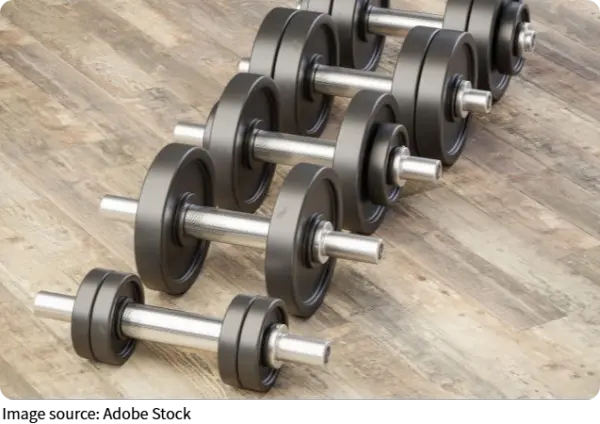
The appropriate dumbbell weight depends on your current strength, experience, and training goals. A manageable resistance is a practical starting point because it allows you to learn the movement while maintaining good technique.
As the exercise becomes more familiar, the training demand can be increased gradually by adjusting the resistance, repetitions, or sets. Changes should allow you to maintain controlled movement rather than compromising technique.
Supporting Everyday Movement
Lower-body strength contributes to many routine activities. Walking, climbing stairs, standing from a chair, and carrying everyday objects all require coordinated movement from the legs and trunk.
The National Institute on Aging explains: “Muscle-strengthening activities improve physical function and can help you stay independent and make it easier to perform everyday activities, such as getting up from a chair, climbing stairs, and carrying groceries.”
Dumbbell squats can be one part of a broader resistance-training program. Combining different exercises allows other major muscle groups and movement patterns to receive appropriate attention.
Building a Balanced Exercise Routine
A well-rounded routine can include resistance training alongside walking, mobility exercises, and other forms of physical activity. The structure of the routine can be adapted to individual goals, experience, available time, and preferred activities.
For resistance exercises, regular participation and appropriate progression are more important than making the routine unnecessarily complicated. Maintaining controlled technique throughout training also helps keep the exercise focused and purposeful.
Dumbbell squats provide a straightforward way to train the lower body while developing controlled movement and coordination. With an appropriate resistance level and consistent technique, they can form a useful part of a balanced exercise routine focused on maintaining strength and everyday physical capability.